This post contains affiliate links (#ad). As an Amazon Associate, I earn from qualifying purchases.
Scene images in this post are illustrations created for this site. See each product listing for the actual item.
Automatic Cat Doors: 10 Smart Picks for Easy Coming and Going
Hand the door duty back to your cat. Microchip and collar-key doors that keep strays out, a timer for nighttime curfews, plus window and room-to-room options that need no cutting at all.
If a cat has ever pulled you out of a warm bed at 3 a.m. to go out, then yowled to come back in five minutes later, you already know the job description. Doorman. Unpaid. On call around the clock.
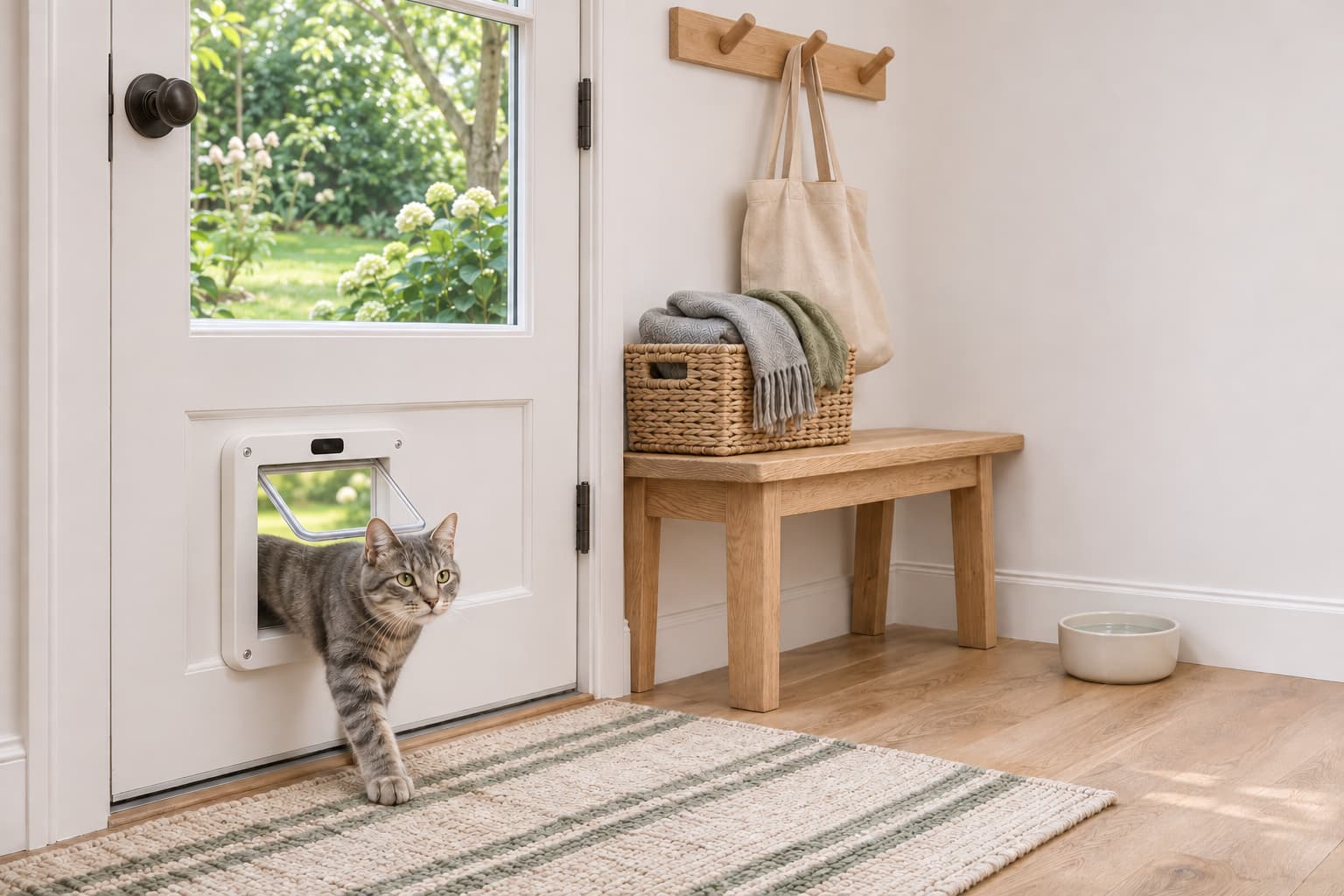
A good cat door hands that job back to the cat. The smart ones read your cat’s microchip or a collar key, so your cat strolls in while the neighbor’s tomcat waits on the porch. Some even add a timer, so everyone’s home by dark without you lifting a finger.
Not ready to take a saw to the back door? We’ve got you covered there too, with window inserts that slide in without a single cut and room-to-room doors that keep the litter box private and the dog out of the cat food.
The Buying Checklist
Before you pick a door, run through these eight quick questions:
- Microchip, collar key, or neither? Microchip doors use the chip your cat already has. Collar-key doors need a tag or magnet your cat wears every day.
- Will your cat fit? Measure across the shoulders and hips. Flap openings in this lineup run from under 5 inches tall to about 9 inches.
- Where will it go? Check your door’s thickness and material. Metal can block chip readers, and glass or walls usually need extra parts.
- Coming in only, or both ways? Some doors check only cats coming in. If you want an indoor cat kept inside, you need one that checks both ways.
- Do you need a curfew? Most doors lock only by hand. A built-in timer can switch to “in only” at dusk for you.
- Raccoons in the neighborhood? Basic flaps can be pried open from outside. A door that locks in both directions gives you better odds.
- Batteries or no power at all? Electronic doors run on batteries, so keep spares. A dead battery can leave your cat stuck on the wrong side.
- Can you cut a hole? Renters and nervous DIYers can skip the saw with a window insert or an adjustable door strap.
Top picks at a glance
- Best overall: SureFlap Microchip Cat Flap
- Best for indoor and outdoor cats: SureFlap DualScan Microchip Cat Door
- Best automatic curfew: Cat Mate Elite I.D. Disc Cat Flap with Timer
- Best budget pick: Cat Mate Electromagnetic Cat Door (254)
- Best for windows: Zerzuo Quick-Fit Cat Door for Windows
- Best room-to-room door: Purrfect Portal Meow Manor
- Best no-cut option: Door Buddy Cat Door Latch and Stopper
The Lineup
Microchip and Collar-Key Doors
1. The Bouncer at the Door: SureFlap Microchip Cat Flap
Tired of the neighbor’s tabby helping itself to your cat’s dinner? This flap reads the microchip your cat already carries and opens only for the cats you’ve registered. No collar to snag, no tag to lose, and everyone else waits on the porch.

SureFlap has been making this flap since 2010, and it’s still the one most people picture when they hear “microchip cat door.” You press one button, let your cat poke its head into the tunnel, and the door learns that chip. It remembers up to 32 cats, so even a crowded household won’t run out of room.
It runs on four AA batteries, so there’s no wiring and no outlet to hunt for. It can go in a door, a window, or a wall, and it slots into the hole left by many older cat flaps. The trade-off: it only checks cats coming in. Anyone already inside can stroll right out.
SureFlap Microchip Cat Flap at a Glance
| Feature | What the brand lists |
|---|---|
| Opens for | Your cat’s microchip (9, 10, and 15-digit) or a SureFlap RFID collar tag, sold separately |
| Won’t read | Chips with numbers starting 000, 010, or 020 |
| Memory | Up to 32 cats |
| Scanning | Entry only; exit is free |
| Locking | 4-way manual dial: in and out, in only, out only, locked |
| Flap opening | Title lists 4 3/4″ H x 5 5/8″ W; description lists 5.59″ W x 5.39″ H |
| Installs in | Doors, windows, or walls (up to 10 inches thick, as listed) |
| Power | 4 AA alkaline batteries, not included; up to 12 months |
| Alerts | Low-battery light |
| App or timer | None |
| Size and weight | 8.94 x 8.74 x 4.92 inches; 1 pound |
Check the Chip Before You Cut
Find your cat’s chip number on its registration papers, or ask your vet or shelter to scan it. If the number starts with 000, 010, or 020, plan on a SureFlap RFID collar tag instead. Then hold your cat up to the flap and make sure it unlocks before you cut a single hole. A door with a hole in it is a lot harder to return.
Measure Your Cat, Not Just the Door
The listing gives two different opening sizes, so plan around the smaller one. Measure your cat across the shoulders and across the hips, since long-bodied cats tend to get hung up at the back end. Cats around 10 pounds usually pass easily. Past about 13 to 15 pounds, it gets snug, and SureFlap’s larger Microchip Pet Door is the safer bet.
What It Won’t Do
There’s no timer, no app, and no Wi-Fi. Curfews happen by turning the dial yourself. It also wasn’t built to outsmart clever paws: in raccoon country, a flap that scans in both directions, like the DualScan up next, is worth the extra money. And if the door faces wind and rain, seal the outside edges with weatherstripping or caulk.
Who It Suits
- Homes where stray or neighborhood cats keep sneaking in
- Microchipped cats of small to average size
- Multi-cat households that want every cat on one door
- Indoor setups too, like a laundry room where the cat can reach the litter box and the dog can’t
It’s a weaker match if your cat is large, if raccoons visit your yard, or if you want a timer or phone control.
Before You Rely On It
A few minutes of prep saves a lot of frustration:
- Test your cat’s chip at the flap before cutting
- Measure your cat at the shoulders and hips
- Buy four AA alkaline batteries, since none come in the box
- Prop the flap open for the first few days and use treats; some cats startle at the click of the lock or their own reflection
- Swap the batteries as soon as the red light flashes, so your cat isn’t stuck on the wrong side
What you’ll Like:
- No collar or tag needed for most chipped cats
- Keeps unregistered cats out
- One-button setup for up to 32 cats
- Battery powered, with no wiring
- 4-way dial for nights and lockdowns
- Low-battery warning light
Keep in mind:
- Checks cats coming in, not going out
- Snug for large or long-bodied cats
- Not designed to stop raccoons
- No timer, app, or remote
- Batteries, collar tags, and mounting parts cost extra
- The lock clicks, so shy cats may need time
- Warranty: three years
Best for: a household with a microchipped, average-size cat and a neighborhood cat problem.
2. Rules for Every Cat: SureFlap DualScan Microchip Cat Door
One cat’s a backyard explorer, the other is strictly an indoor gentleman. This flap reads microchips on both sides, so you decide who gets to leave and who just gets to come home. Every registered cat can always get back in, and everyone else stays out.
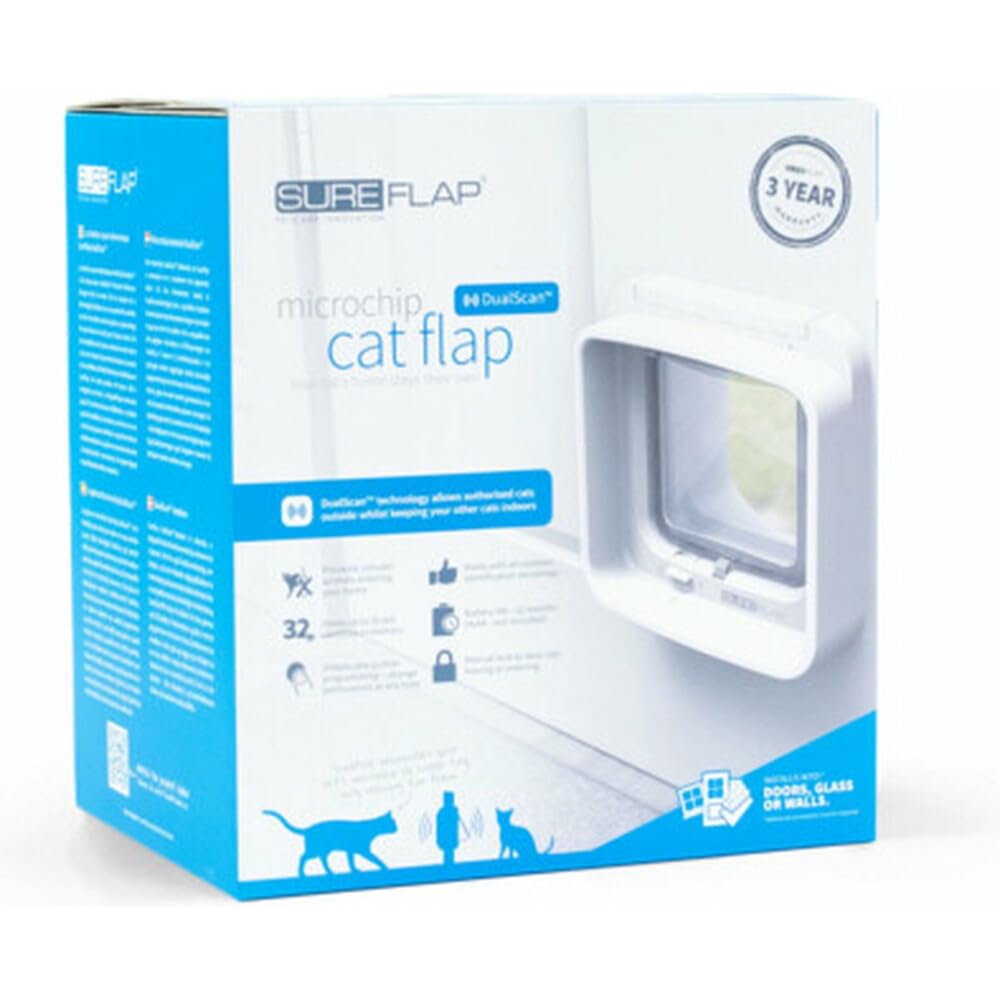
The DualScan looks a lot like the classic SureFlap, but it has a second scanner facing indoors. That small change makes a big difference. You can let the adventurer roam, keep the kitten or the senior cat inside, and still let any of them back in if one slips out by accident.
Because the flap won’t open from either side without a registered chip or tag, nothing can just lift it from outside and walk in. It remembers up to 32 pets and runs on four AA batteries. A 4-way dial handles whole-household lockdowns on vet days or stormy nights.
SureFlap DualScan at a Glance
| Feature | What the brand lists |
|---|---|
| Opens for | Your cat’s microchip or a SureFlap RFID collar tag, sold separately |
| Scanning | Both directions, with in and out permissions set for each cat |
| Memory | Up to 32 pets |
| Locking | 4-way manual dial for the whole household |
| Flap opening | About 4 3/4″ H x 5 5/8″ W |
| Hole to cut | About 6.5″ x 6.8″ (16.6 x 17.2 cm) |
| Door thickness | 3–60 mm (about 1/8″ to 2 3/8″); extends with tunnel add-ons |
| Installs in | Doors and walls; glass with an adapter, sold separately |
| Power | 4 AA batteries, not included; low-battery display |
| App or timer | None |
| Size and weight | 8.27 x 8.27 x 5.83 inches; 2.2 pounds |
Indoor Cats, Outdoor Cats, One Door
Here’s how most households set it up: outdoor cats get in-and-out access, and indoor cats get in-only. If the indoor cat ever sneaks out a window, it can still let itself back in. It works on interior doors too. Some owners use it on a bedroom or a feeding room, so only certain cats get through, which is handy when two cats don’t get along.
Raccoons: Better Odds, Not a Guarantee
The DualScan was built for the problem the basic SureFlap has, where a clever paw lifts the flap from outside. Plenty of owners say the raccoons gave up. A few say a determined one still worked its way in. One more catch: the door relocks about a second after a cat passes, so a cat lingering at the flap can keep it unlocked long enough for something to follow.
Help Your Cat Learn the Click
When the chip is read, the lock releases with a firm click, and some cats bolt the first few times. Tape the flap open for a few days so your cat gets used to walking through. Then let it hear the click with treats on the other side. Your cat also has to push its head fully into the tunnel, not paw at the flap. If the door is mounted high, a step in front helps while your cat learns.
Who It Suits
- Homes with both indoor and outdoor cats
- Yards where raccoons or strays keep testing the cat door
- Owners who want a kitten, senior, or recovering cat kept inside
- Interior doors where only certain cats should pass
It’s a weaker match for large cats, shy cats who scare easily, or anyone who wants a timer or app control.
Before You Rely On It
A little testing now saves a stranded cat later:
- Test your cat’s chip at the flap before cutting; older chips can drift out of reading range, so ask your vet if it struggles
- Measure your cat at the shoulders and hips
- Check the instructions if your door is metal or has metal nearby
- Use fresh alkaline AAs, not rechargeables
- Keep a spare programmed tag to test the flap now and then
- Swap batteries at the first warning, since the flap stays locked when power runs out
- Seal the outside edges if the door faces rain; the battery compartment isn’t watertight
What you’ll like:
- Separate in and out rules for each cat
- Won’t open from either side without a registered chip or tag
- No collar needed for most chipped cats
- Room for up to 32 pets
- Works on interior doors as well as exterior ones
- Low-battery display
Keep in mind:
- Snug opening for large or long-bodied cats
- The lock clicks loudly, and some cats need time
- A closely following cat can slip through
- No timer, app, or hub connection
- Glass adapter, tunnel extensions, and collar tags cost extra
- Test it early, while you can still return it, so a faulty unit doesn’t drain batteries or leave your cat stuck
- Warranty: three years
Best for: households with indoor and outdoor cats, or raccoons testing the door.
3. Curfew on Autopilot: Cat Mate Elite I.D. Disc Cat Flap with Timer
Want the cats home by dark without standing at the back door calling their names? This flap runs on a timer, so it can switch to “come in only” at dusk and open back up in the morning. A collar disc tells it which cats belong, and everyone else stays outside.
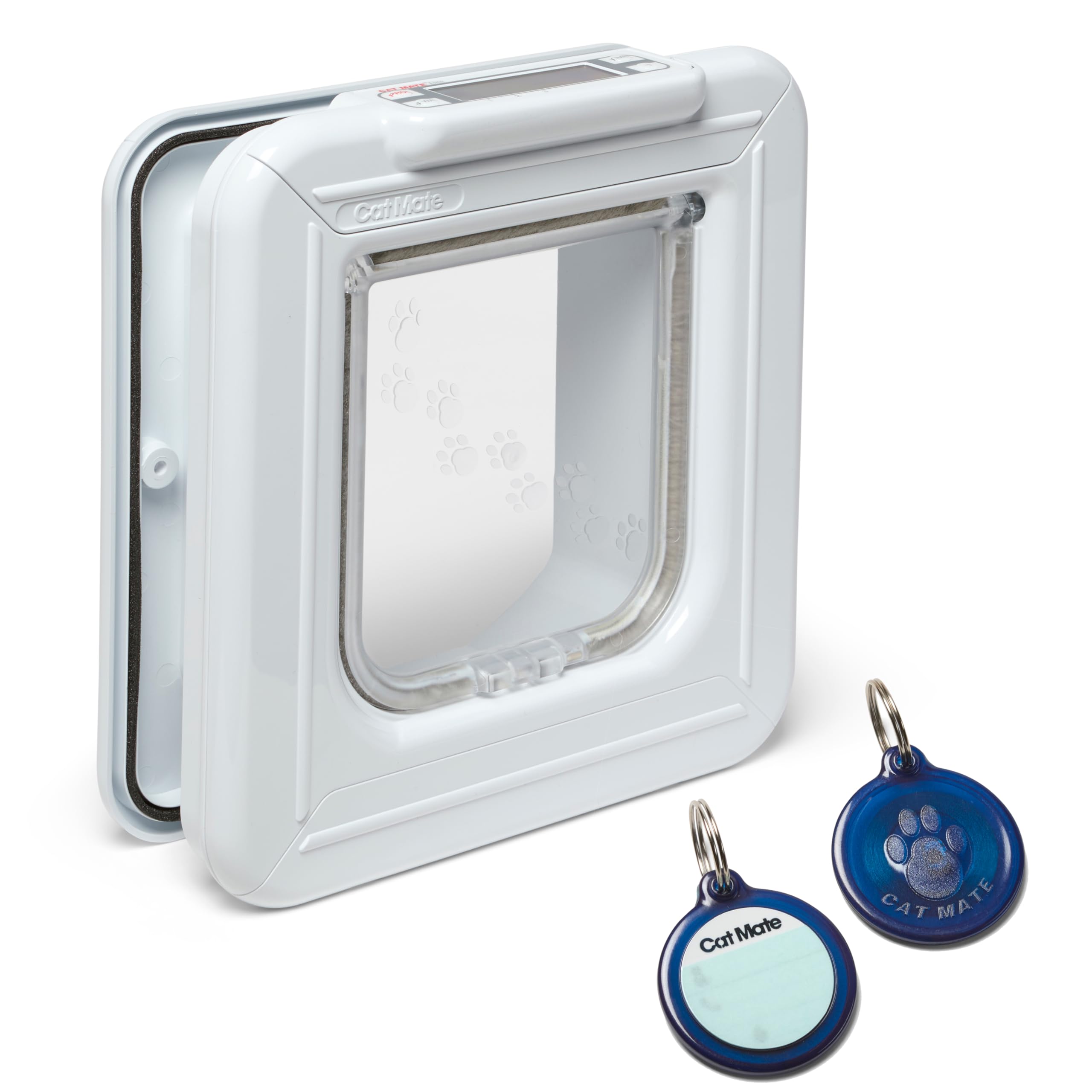
The Elite skips the microchip and uses a small I.D. disc that clips onto your cat’s collar. Two discs come in the box, and the flap can learn up to nine. That’s handy if your cats aren’t chipped, or if their chips are the kind other doors can’t read. It controls both directions, so a disc is needed to go out as well as to come in.
The timer is where it earns its keep. Most owners set “in only” for the night, so stragglers can come home but nobody leaves until morning. A small screen shows the lock setting and whether up to three chosen cats are inside or out, plus how long since they last used the flap. A brush seal and magnetic closure help keep drafts out.
Cat Mate Elite I.D. Disc at a Glance
| Feature | What the brand lists |
|---|---|
| Opens for | Cat Mate I.D. discs worn on the collar (does not read microchips) |
| Discs included | 2; extras sold separately |
| Memory | Up to 9 cats |
| Access control | Entry and exit |
| Locking | 4-way: in and out, in only, out only, locked |
| Timer | Switches lock modes on a schedule |
| Display | LCD shows lock status, plus location and last use for 3 selected cats |
| Flap opening | 5 11/16″ x 5 11/16″ (145 mm) |
| Hole to cut | 7 1/16″ W x 8 1/16″ H |
| Overall size | 9 3/4″ W x 10 3/8″ H |
| Door thickness | Self-lining up to 2 inches |
| Weather | Brush-sealed flap with magnetic closure |
| Power | 4 AA batteries |
| Weight | 2.3 pounds |
Setting the Night Shift
The timer changes the lock mode for the whole household on a schedule you set. “In only” from evening to morning is the classic routine. Owners disagree on whether each cat can get its own hours, and the brand describes the timer as covering all cats, so plan on one shared schedule. Keep the manual handy: the buttons take some practice, and the screen is hard to read in dim light.
Living With a Collar Disc
The disc is about the size of a quarter, so it can jingle and dangle into food bowls. A snug breakaway collar and a small zip tie around the ring keep it quieter. Cats lose collars, so buy a spare disc or two now rather than at 11 p.m. with a cat locked outside. If your cat won’t wear a collar at all, this isn’t the flap for you.
Use Training Mode First
Training mode leaves the flap unlocked so your cat can learn to push through without the click of the lock. The timer and disc checks pause while it’s on. Give it a few days, then switch to normal mode. Your cat needs to push its head gently against the flap, wait a beat for the lock to release, then walk through. Some cats get it in an hour, others take a couple of weeks.
Who It Suits
- Owners who want cats in at night without doing it by hand
- Cats that aren’t microchipped, or whose chips other doors can’t read
- Multi-cat homes with up to nine cats
- Larger cats that find SureFlap openings tight
- Interior doors, including hollow-core ones
It’s a weaker match for cats that won’t wear a collar, very skittish cats, or anyone who wants an app.
Before You Rely On It
Test the schedule before you trust it with a cat outside:
- Measure your cat against the 5 11/16″ opening
- Check that your door is 2 inches thick or less; walls need a separate liner
- Don’t plan on cutting tempered glass or a screen door
- Keep metal away from the flap, which can shorten the reading range
- Program the timer, then watch it switch modes for a few days
- Buy a spare disc and keep fresh batteries on hand
What you’ll like:
- Built-in timer for nightly curfews
- Controls both entry and exit
- Works without microchips
- Room for up to nine cats
- Roomier opening than many microchip flaps
- Screen shows who’s in and who’s out
- Training mode for an easy start
Keep in mind:
- Your cat must wear a collar disc
- Discs are bulky and easy to lose
- The lock whirs and clicks, so keep it away from bedrooms
- Timer setup has a learning curve
- Screen tracks only three cats
- Test the timer early, while you can still return the flap
- Warranty: three years
Best for: owners who want an automatic nighttime curfew without microchips.
4. The Collar Key: Cat Mate 4-Way Locking Electromagnetic Cat Door (254)
Here’s the simplest way to keep the neighborhood tomcat out of your kitchen. Your cat wears a small magnet on its collar, and the flap only lets in cats that carry one. No programming, no app, and it costs about half as much as a microchip door.
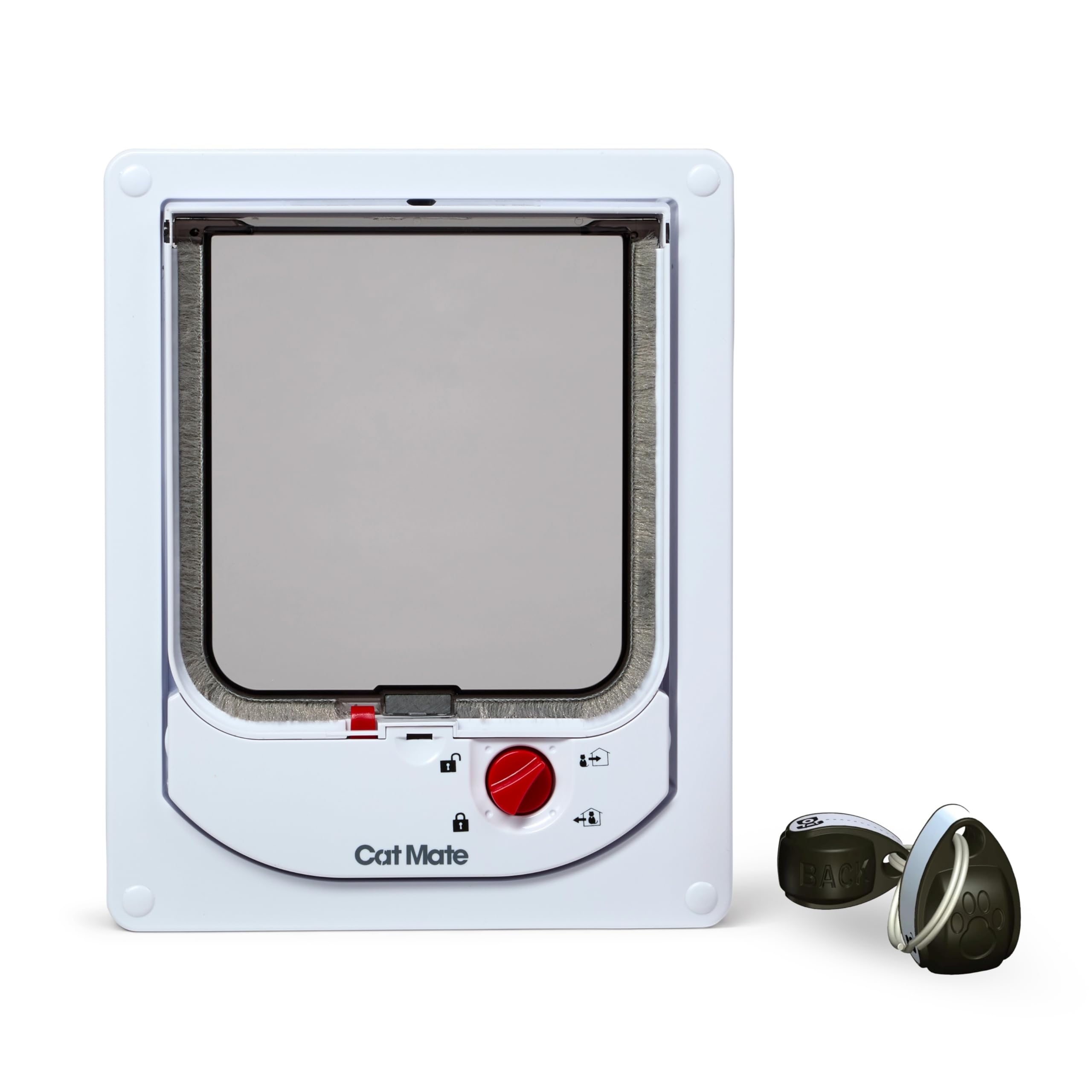
The 254 has been around for years, and it works on a refreshingly simple idea. A small magnet on your cat’s collar acts like a house key. When your cat pushes its head up to the flap, the door senses the magnet and releases the latch. Two magnets come in the box, so a two-cat home is covered from day one.
It only checks who’s coming in, so any animal inside can go back out. A 4-way dial lets you set in and out, in only, out only, or locked. Brush seals, a magnetic closure, and a rain seal help with drafts, and one 9-volt battery runs it.
Cat Mate 254 at a Glance
| Feature | What the brand lists |
|---|---|
| Opens for | Cat Mate collar magnets (2 included; collars not included) |
| Access control | Entry only; any animal can exit |
| Locking | 4-way manual dial: in and out, in only, out only, locked |
| Timer or app | None |
| Flap opening | 5 11/16″ x 5 11/16″ (145 mm) |
| Hole to cut | 6 5/8″ W x 8 5/8″ H |
| Overall size | 7 5/8″ W x 9 1/2″ H |
| Door thickness | Self-lining up to 2 3/8″ (60 mm) |
| Installs in | Wood, UPVC, and metal doors, or walls |
| Weather | Brush seals, magnetic closure, rain seal |
| Power | One 9-volt battery, not included |
| Weight | 1.6 pounds |
Height and Magnet Make or Break It
Most trouble with this door comes from setup, not the door itself. Mount it so the bottom of the opening sits level with the bottom of your cat’s belly. Clip the magnet straight onto the collar with the paw print facing forward, hanging below the chin where it can’t twist. The sensing range is short, so your cat has to push its head right up to the flap. Get those two things right, and the door does its job.
What a Magnet Can’t Do
Every Cat Mate magnet is the same, so the door can’t tell one cat from another. If you want one cat in and one out, this isn’t your door. Exiting is wide open, which means a clever raccoon can hook the flap and pull it outward. Cat Mate itself doesn’t call this door raccoon-proof and points raccoon households to the Elite above.
Who It Suits
- Budget shoppers who want stray cats kept out
- Cats that already wear a collar without fuss
- Homes with any number of cats, since each just needs a magnet
- Interior doors, like a bedroom hideaway for an older cat with bossy housemates
It’s a weaker match for raccoon country, cats that slip their collars, or homes that need different rules for different cats.
Before You Rely On It
A few checks keep your cat from getting stuck outside:
- Hold the magnet up to the flap and confirm it unlocks before you cut
- Mark the height at the bottom of your cat’s belly
- Skip screen doors; on a metal door, ask about framing the hole in wood
- Buy a 9-volt battery and keep a spare, since a dead battery can leave your cat locked out
- If the flap won’t close fully, loosen the frame screws slightly; a twisted frame is the usual culprit
- Keep an extra collar and magnet on hand
What you’ll like:
- Lowest price among the automatic picks
- No programming; the magnet works out of the box
- Two magnets included
- Works with as many cats as you have magnets
- Brush seals and rain seal for drafts
- 4-way dial for nights and lockdowns
Keep in mind:
- Checks cats coming in, not going out
- Not raccoon-proof, per the brand
- Your cat must wear a collar
- Short sensing range and fussy magnet position
- No timer; curfews are set by hand
- Test it early, while you can still return it
- Warranty: three years
Best for: collar-wearing cats in homes that want strays out for the least money.
5. The Room Keeper: CUIBIRD Smart Cat Door with 4 Collar Keys and Remote
One cat raids the other’s dinner. The dog treats the litter box like a snack bar. This door gives each cat its own collar key and lets you set the rules from across the room with a remote. And its opening is the roomiest of our automatic picks.
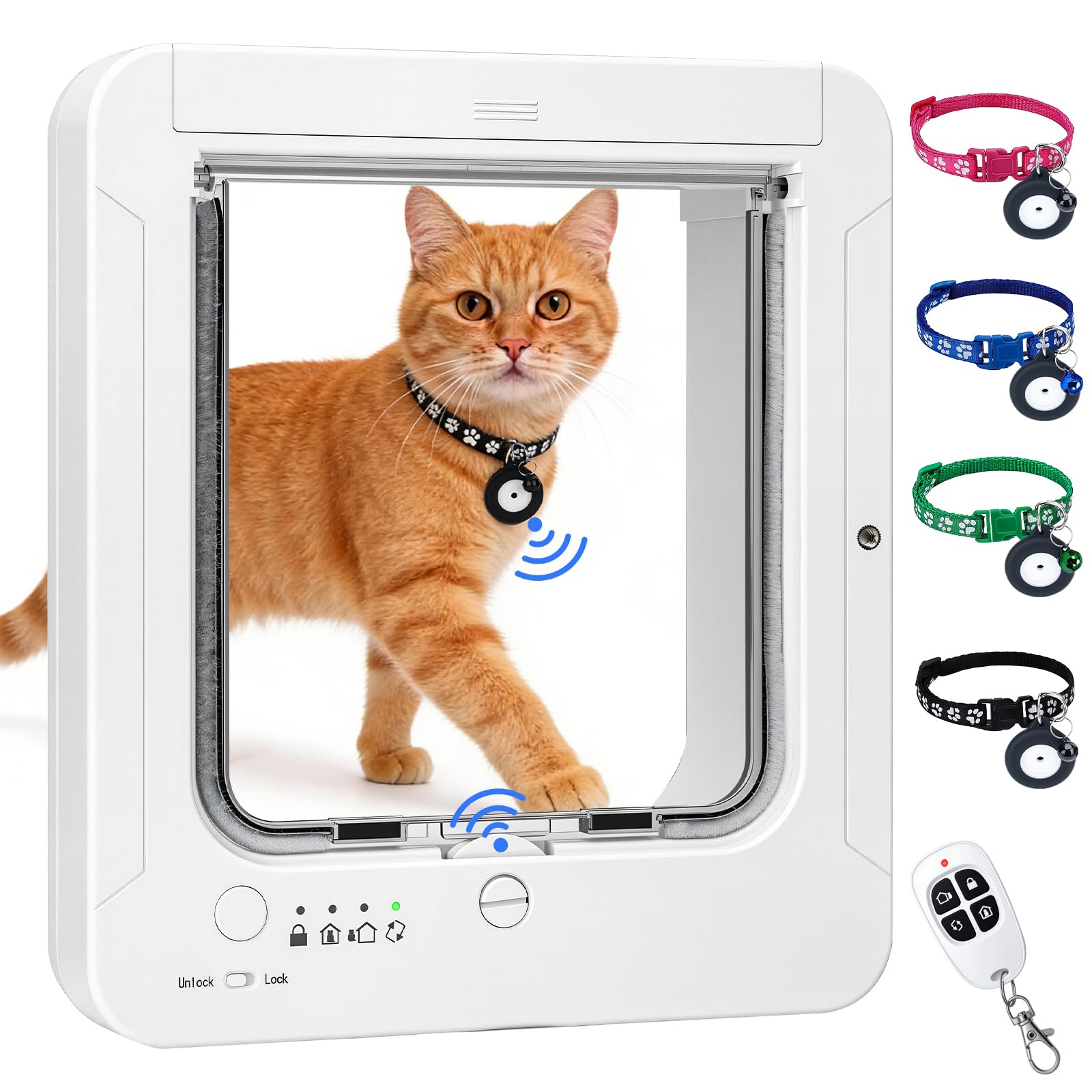
The CUIBIRD M1 is built for life inside the house. Put it on a feeding room, a laundry room with the litter box, or a bedroom, and only the cats wearing a key can get through. Four collar keys come in the box, so a busy multi-cat home is ready to go on day one.
Its opening is a generous 7.7 inches wide by 8.2 inches tall, so bigger cats that squeeze through smaller flaps can walk right in. A 4-way lock and a remote let you change settings without getting off the couch. It comes in white, black, or brown to match your door.
CUIBIRD Smart Cat Door at a Glance
| Feature | What the brand lists |
|---|---|
| Opens for | RFID collar keys (4 included, with collars) |
| Controls | 4-way lock plus remote control |
| Timer or app | None listed |
| Flap opening | 7.7″ W x 8.2″ H |
| Overall size | 10″ W x 11.6″ H |
| Pet fit | Chest under 7.83″ wide, under 8.34″ tall, under 20 pounds |
| Door thickness | Up to 3 inches |
| Installs in | Wood doors, PVC doors, walls, pet houses (metal may block the tag reader) |
| Material | ABS plastic |
| Colors | White, black, brown |
Best Behind Closed Doors
The title says interior and exterior, but everything about this door points indoors. The listing gives no weather rating, and it’s not built to seal out a winter wind. Where it really shines is a room inside the house: the feeding room where only the dieting cat’s sister may enter, or the litter corner the dog keeps raiding. One owner set it up in about 12 minutes.
Get Close to the Sensor
The door unlocks when a collar key comes near, but “near” means close. Your cat needs to bring its head within about 2 inches of the sensor, then push the flap open itself, because the flap doesn’t swing open on its own. Treats on the other side help it learn. Keep metal away, too: the brand warns that metal doors and walls can block the tag reader.
Who It Suits
- Multi-cat homes that need separate feeding spaces
- Homes where a dog keeps getting into the litter box or cat food
- Bigger cats that find small flaps tight
- Owners who like adjusting settings by remote
It’s a weaker match for exterior doors in cold climates, metal doors, or anyone who wants a long track record.
Before You Rely On It
Test it on the floor before you cut anything:
- Power it up and check that each collar key unlocks the door
- Measure your cat’s chest width and height against the size chart
- Move the tag to your cat’s own breakaway collar; one owner says the included collar doesn’t break away
- Watch untagged pets at first, since a paw poked into the flap can get caught
- Keep spare batteries for the door and the remote
- Test it well within the return window, since some locks have failed early
What you’ll like:
- Roomiest opening of the automatic picks
- Four collar keys included
- Remote control for quick changes
- 4-way lock
- Quick, simple install
- Three colors to match your door
Keep in mind:
- Your cats must wear collar keys
- Short sensor range; heads need to come close
- The flap unlocks but doesn’t open itself
- Not sealed for outdoor weather
- Metal doors can block the reader
- Newer product, with some early lock failures reported
- Warranty: not listed; check with the seller
Best for: indoor rooms where each cat, and not the dog, gets its own key.
For Windows: No Cutting Required
Can’t cut a hole in a door or wall? Renting, or just not ready to take a saw to the house? These window inserts slide into a window you already have and come out again when you move. They aren’t automatic. Any cat that pushes the flap can use it, but they give your cat its own way in and out without a single cut.
6. The Catio Connector: Zerzuo Quick-Fit Cat Door for Windows
Your cat wants the catio, you want to finish your coffee. This aluminum insert drops into a sliding window in minutes and gives your cat its own magnetic flap. No saw, no drill, and it comes right back out on moving day.
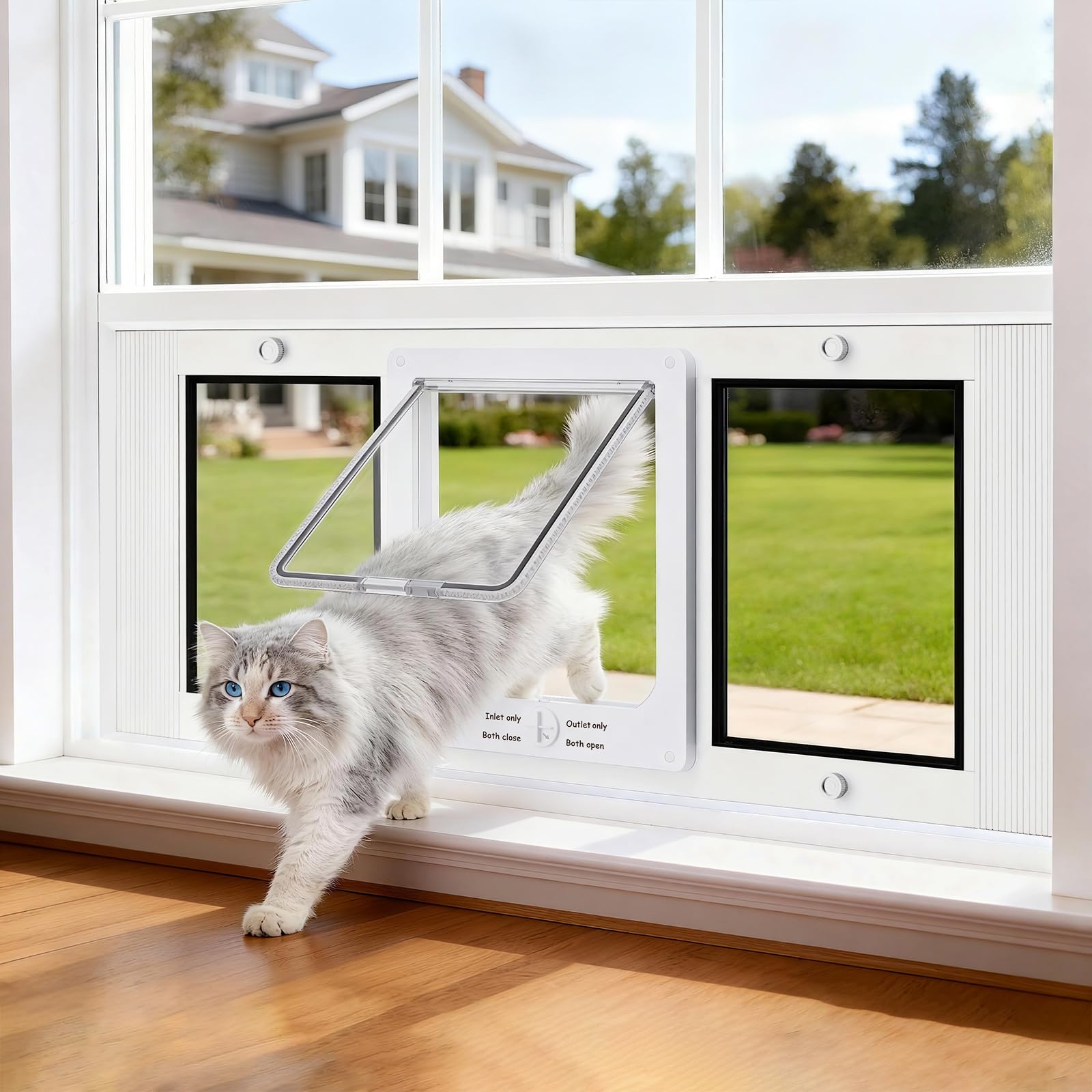
The Quick-Fit is made for windows that slide up and down. You open the lower sash, set the frame in the track, expand it to fit, and close the window down on top of it. Owners say it takes just a few minutes. A sturdy aluminum frame holds glass panels on either side of a clear, self-closing flap, and it’s roomy enough that even a 23-pound Maine Coon gets through.
It comes in four widths, from 23 inches up to 40, so most standard windows have a match. The flap closes with a magnet and has a lock dial for nights or stormy days. Extra weatherstripping comes in the box to seal the gap at the top of the window. It’s a favorite for catios, screened porches, and barn cats.
Zerzuo Quick-Fit at a Glance
| Feature | What the brand lists |
|---|---|
| Window type | Vertical (up-and-down) sliding windows only |
| Sizes | S 23″–28″, M 27″–32″, L 31″–36″, XL 35″–40″ |
| Track width | Measure against 0.9″ to choose inside or outside fit |
| Flap | Clear flap with magnetic auto closure |
| Locking | Dial with multiple closure settings |
| Selective entry | None; any pet that pushes the flap can pass |
| Frame | Aluminum, with glass panels |
| Weather | Seals and weatherstripping included |
| Pet size | Most medium cats and small dogs |
| Power | None needed |
| Weight | 8.9 pounds |
Measure Twice, Order Once
Fit is everything here. First, measure the width of your window track. If it’s wider than 0.9 inch, measure the inside length of the track from side to side. If it’s narrower, measure the outside length instead. Then pick the size that covers your number. It only works in windows that slide up and down, so side-to-side sliders, crank-out casements, and sliding glass doors are out.
Mind the Glass and the Gaps
The glass panels beside the flap are clear, and a cat racing for the opening can misjudge them. A couple of decals or stickers on the glass help your cat see where the door is. Air can also sneak in where the upper and lower window sashes meet, so add a strip of weatherstripping there if you live somewhere cold. And with the insert in place, your regular window latch may not catch, so a sash stop or wedge keeps the window secure.
Who It Suits
- Renters who can’t cut doors or walls
- Homes with a catio, screened porch, or safe yard
- Big cats, including Maine Coons
- Anyone who wants a no-power, no-battery option
It’s a weaker match if you need to keep strays or raccoons out, or if your windows slide sideways or crank open.
Before You Rely On It
A little setup makes it safer and snugger:
- Measure your track and window width before ordering
- Put decals on the glass panels so your cat sees them
- Add weatherstripping where the window sashes meet
- Use a sash stop or wedge, since the window latch may not catch
- Prop the flap open for the first day or two while your cat learns
- Check the flap and dial when it arrives, and test the lock with your cat
- Add a step on both sides if the window sits high
What you’ll like:
- No cutting, drilling, or wiring
- Installs in minutes and removes easily
- Four sizes to fit most up-and-down windows
- Sturdy aluminum frame
- Roomy enough for big cats
- Extra weatherstripping included
Keep in mind:
- Not automatic; any pet that pushes the flap can enter
- The plastic flap and dial are less sturdy than the frame
- The flap doesn’t always settle closed, so locking can be fiddly
- A determined cat may push through when it’s locked
- No bug screen
- Only fits up-and-down sliding windows
- Warranty: not listed
Best for: renters and catio owners with an up-and-down sliding window.
7. Small Window, Big Freedom: Tonho Dawnhawk Clear Cat Door for Window
Got a narrower window and a cat with places to be? This clear panel slips into an up-and-down window and gives your cat its own flap, while the view and daylight stay right where they are. It’s the lowest-priced pick in this lineup.
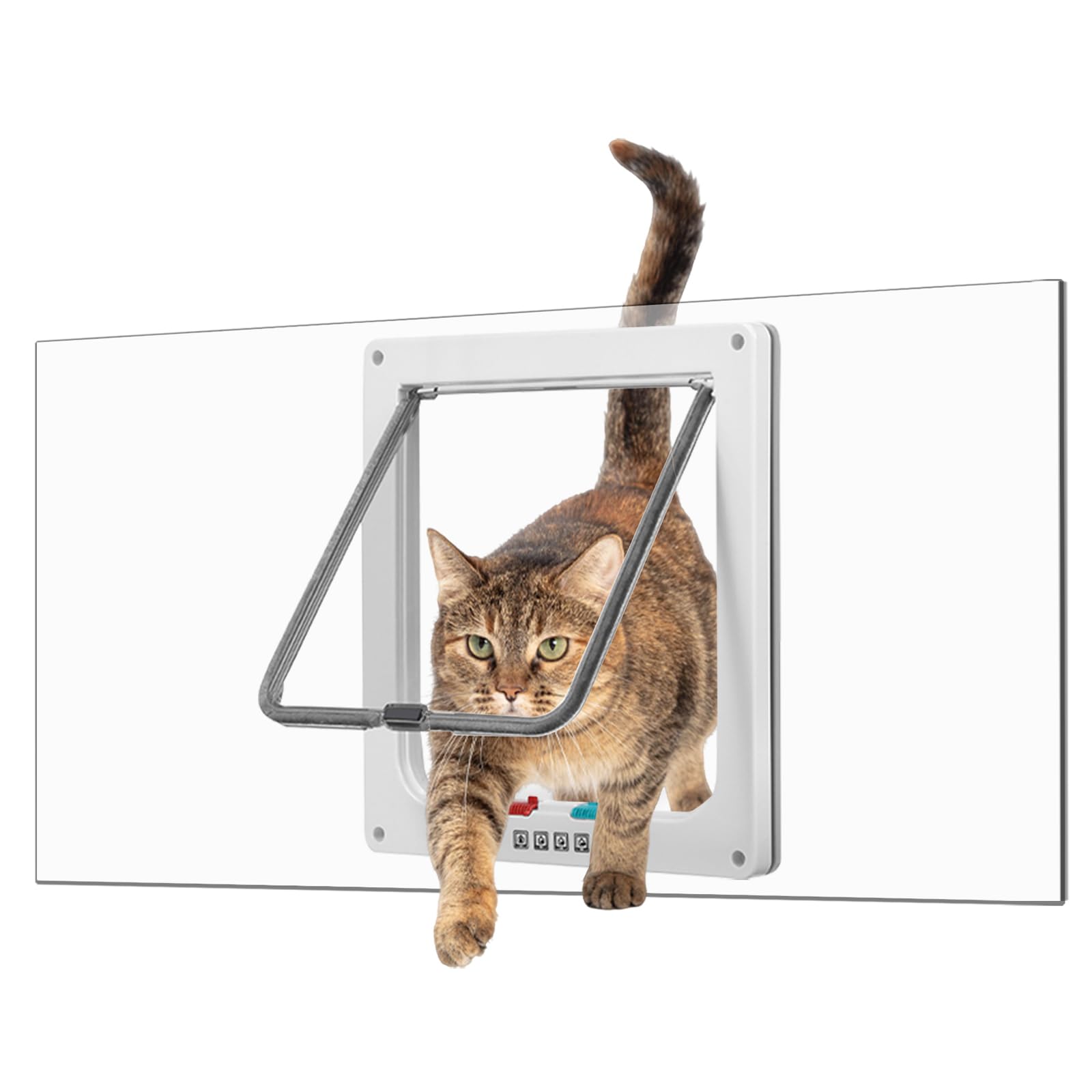
The Tonho Dawnhawk is a 28-inch Plexiglass panel with a cat flap built in. You trim it to your window’s width, set it in the track, and close the window down on top of it. Owners say that last part takes seconds. Because the panel is clear, your cat can still sit and watch the birds, and you can watch your cat come and go.
Red and green slide switches give you four modes: free in and out, in only, out only, or locked. “In only” is the evening favorite, since your cat can come home but not wander off again. A magnetic bottom edge pulls the flap closed, and a brush seal helps with breezes. Need a different width, or more privacy? It also comes in other sizes and a frosted version.
Tonho Dawnhawk at a Glance
| Feature | What the brand lists |
|---|---|
| Window type | Vertical (up-and-down) sliding windows |
| Fits | Windows 18″–28″ wide (other sizes sold separately) |
| Panel | Clear Plexiglass, 28″ W x 14″ H; frosted option available |
| Trimming | Cut to width with a hand saw or power saw |
| Smallest cut size | 11.8″ x 11″ |
| Flap | Clear vinyl with rounded edges, magnetic bottom |
| Locking | 4 modes: free in and out, in only, out only, locked |
| Selective entry | None; any pet that pushes the flap can pass |
| Weather | Brush strip seal |
| Power | None needed |
Yes, You’ll Need a Saw
“Adjustable” here means “cut to fit.” Measure your window first. Check how deep the track is: if it’s under 0.2 inch, measure the inside of the window frame; if it’s deeper, measure the track itself. Then mark the panel and cut slowly with a fine-tooth saw, with the panel well supported and eye protection on. Plexiglass can crack if you rush. No saw? A hardware store or frame shop can make the cut for you.
Snug It Up
Once it’s in, give the panel a wiggle. If it shifts as your cat passes through, press foam weatherstripping along the edges so it sits tight in the track. A strip across the top of the flap frame helps with drafts too. And if your cat is the clever type, keep an eye on the slide switches: some cats learn to paw them open, so it’s not the door to trust for a strict overnight lockdown.
Who It Suits
- Renters with narrower up-and-down windows
- Budget shoppers who don’t mind a little DIY
- Kitchen, laundry-room, or catio windows
- Owners who want to keep the view and daylight
It’s a weaker match if you don’t have a saw, live somewhere very cold, or have a cat that won’t stay put once locked in.
Before You Rely On It
A little prep turns a good idea into a good fit:
- Measure twice before cutting; a panel cut too short can’t be fixed
- Cut slowly with the panel supported, and wear eye protection
- Peel off the protective film before installing
- Check the screws when it arrives and tighten or replace any bent ones
- Add foam strips if the panel wobbles in the track
- Use a sash stop so the window can’t be pushed up from outside
- Give your cat a step on both sides of the window
What you’ll like:
- Lowest price in the lineup
- No drilling or window damage
- Clear panel keeps the view and daylight
- Four lock modes, including in only
- Several sizes, plus a frosted option
- No batteries or power needed
Keep in mind:
- You must cut the panel with a saw
- Plexiglass can crack if cut too fast
- The panel may wobble without extra foam strips
- Clever cats can paw the switches open
- Drafts can sneak around the flap
- Not automatic; any pet that pushes the flap can enter
- Warranty: not listed
Best for: handy renters with a narrow up-and-down window and a tight budget.
Bonus: Room-to-Room Cat Doors
Not every cat door leads outside. These are for life inside the house: a way into the laundry room litter box, a bedroom you’d like to keep closed, or a feeding spot the dog can’t reach. They’re simple, quiet, and a lot cheaper than anything above.
8. A Tiny Front Door for Your Cat: Purrfect Portal Meow Manor Interior Cat Door
Your cat gets its very own front door, complete with arched trim, little windows, and a doorknob. Close the big door, and your cat still strolls in and out of the litter room or bedroom like it owns the place. Which, let’s be honest, it does.
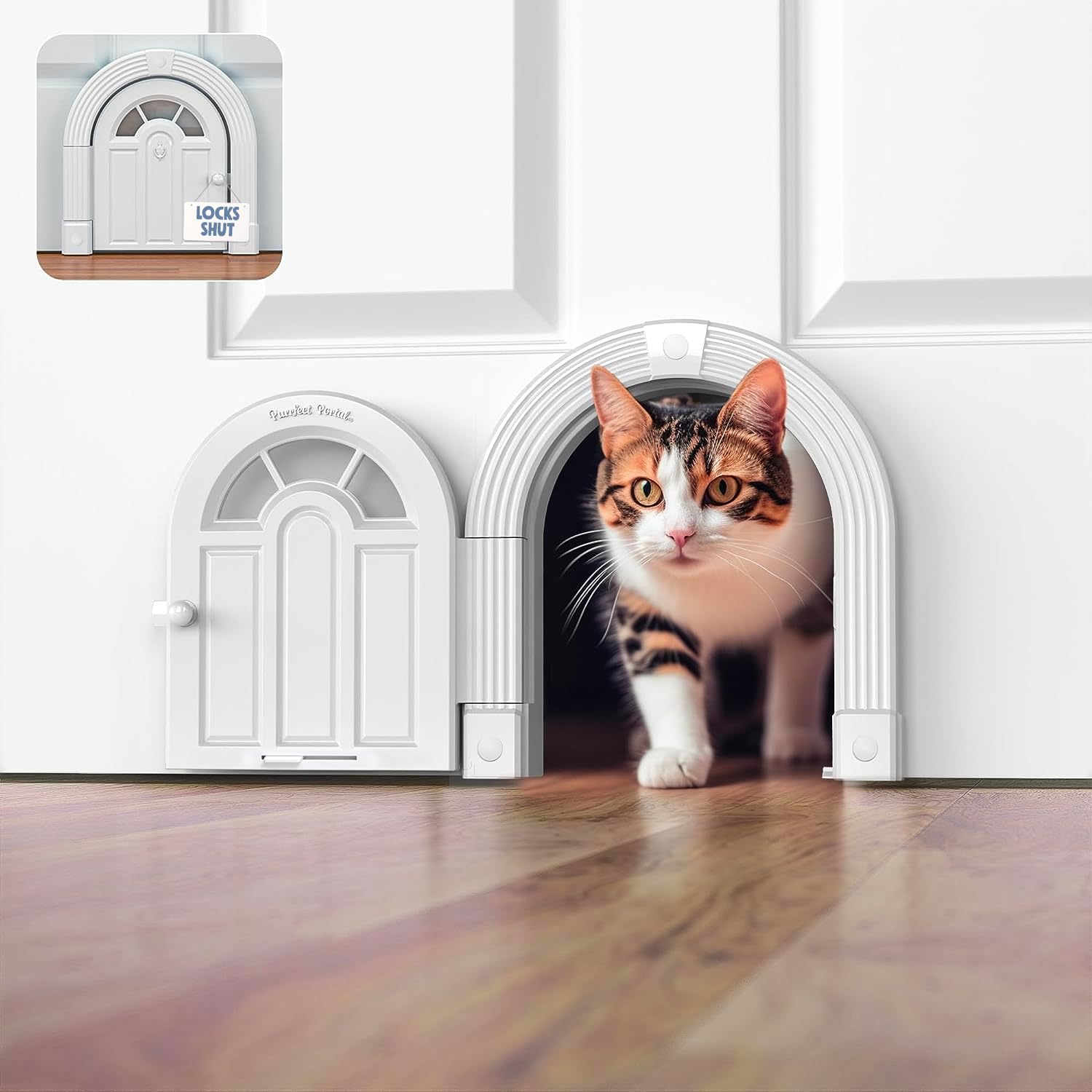
The Meow Manor fits interior doors 1.25 to 1.75 inches thick, solid or hollow-core, and sits at the bottom of the door like a miniature entryway. There’s no flap to push. Prop the tiny door open with the included door stop, and your cat walks right through. Most cats use it the first day.
When you need the room closed, say for a vet trip or while company is over, swing the little door shut and turn the knob to latch it. It comes in seven colors, and owners paint them to match their trim. Got a big cat? There’s a Meow Manor XL too.
Meow Manor at a Glance
| Feature | What the brand lists |
|---|---|
| Use | Interior doors (brand recommends indoor use) |
| Door thickness | 1.25″–1.75″, solid or hollow-core |
| Opening | About 9.25″ H x 9″ W |
| Cat size | Up to 20 pounds; XL size available |
| Little door | Hinged, opens one way, knob latch locks it closed |
| Hold-open | Door stop included |
| In the box | Cutout template, instructions, screws, and caps |
| Material | ABS plastic; paintable with paint made for plastic |
| Colors | White, black, blue, gray, peanut brown, white with gold or silver accents |
| Power | None needed |
| Weight | 1.37 pounds |
How the Little Door Works
Think of it as a real door, just small. It swings open one way and latches from one side only, so when it’s shut, no one gets through from either side. Day to day, most owners keep it propped open with the door stop and close it only when the room needs to stay shut. Open, it swings out about 18 inches, so leave clear floor space beside it.
Cutting Day
You’ll need a jigsaw, a screwdriver, and a little sandpaper. Most people take the door off its hinges first, since a jigsaw needs room to work. Tape the cutting area with painter’s tape, then hold the template against the frame before you trace it. Some owners found the template a bit generous. Cut on the small side: you need solid door around the hole for the screws to grip, and you can always sand a little more.
Who It Suits
- Homes with the litter box behind a closed door
- Owners who want the bedroom door shut without trapping the cat
- Homes with a big dog who keeps raiding the cat food
- Anyone who wants a cat door with real charm
It’s a weaker match for keeping out small dogs, since a pup around 15 pounds can often squeeze through, or for tall cats who’d rather not duck.
Before You Rely On It
Measure your cat, your door, and your dog:
- Check that your door is 1.25 to 1.75 inches thick
- Measure your cat’s shoulder height; tall cats may need the XL
- Measure your dog’s chest if keeping it out is the goal
- Match the template to the frame before you cut
- Avoid decorative panel ridges, where the frame can’t sit flush
- If painting, keep paint off the hinges and latch
What you’ll like:
- Most cats use it right away
- No flap, no noise, no batteries
- Locks closed when you need the room shut
- Door stop included
- Seven colors, and paintable
- Lowest price of the bunch
Keep in mind:
- You’ll cut a permanent hole in the door
- Small dogs can often fit through
- Tall cats may have to duck
- The template can run large, so check before cutting
- The knob can be stiff, and a clever cat may learn it
- Doesn’t contain litter smell when open
- Warranty: not listed
Best for: keeping the litter room or bedroom door closed without locking the cat out.
9. Straight Out of a Storybook: Purrfect Portal Gnome Door Interior Cat Door
Every cat secretly believes it lives in a fairy tale. This one makes it official. The Gnome Door turns the bottom of an ordinary door into a little round garden-gnome entry, complete with a porthole window and a working doorknob. Guests will stop and smile. Your cat will just walk on through like royalty.
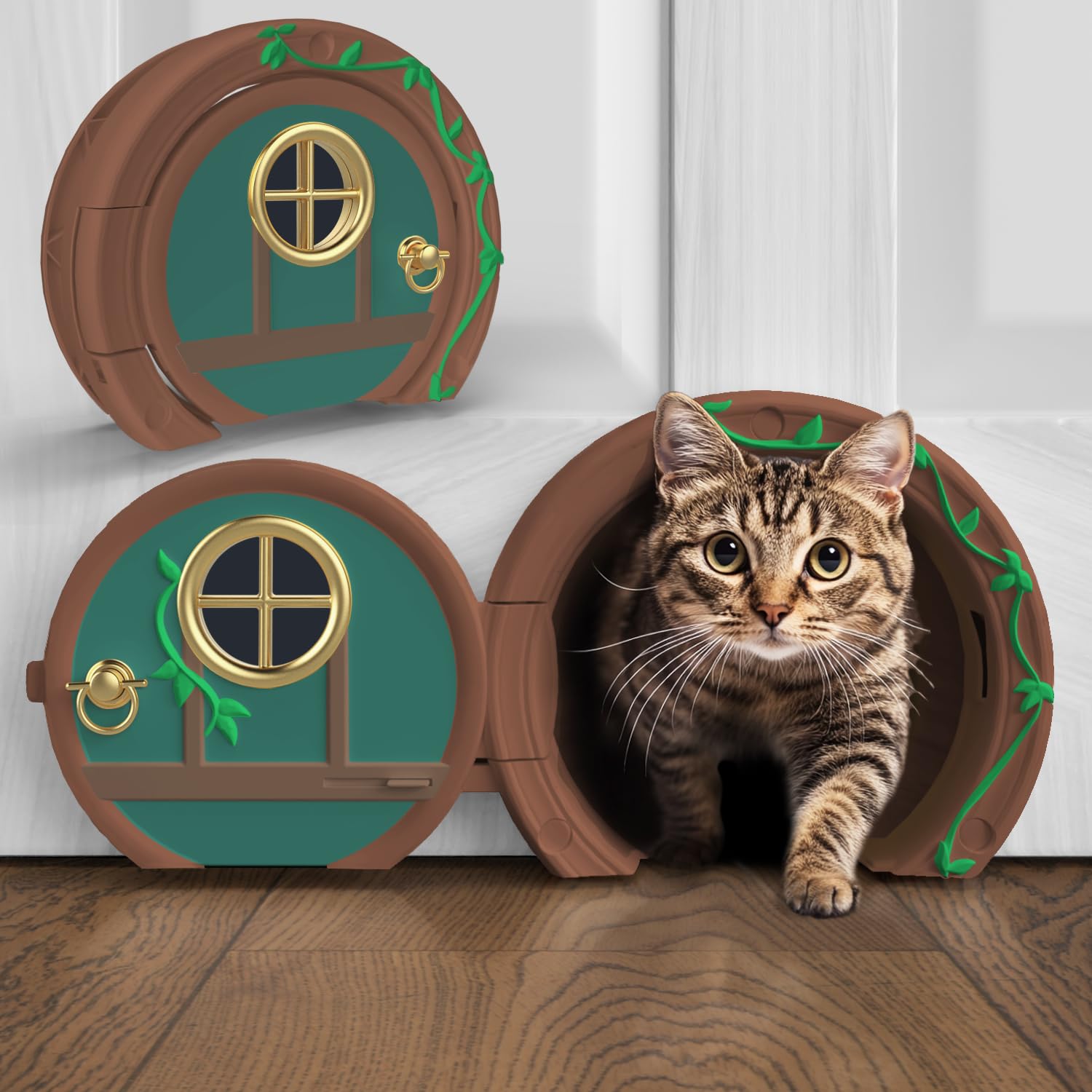
From the same folks behind the Meow Manor, the Gnome Door swaps the arched-trim look for a round, whimsical cottage door. It’s made for hollow interior doors, like a bedroom, closet, or the laundry room where the litter box lives. And it looks finished from both sides, so nobody’s stuck staring at a plain hole.
Slide the latch to hold the little door open for everyday traffic, or close it and turn the knob when the room needs to stay shut. Owners say cats up to 17 or 18 pounds walk through fine, while most dogs can’t. Pick from brown and green, plain brown, white, blue, or pink and gold.
Gnome Door at a Glance
| Feature | What the brand lists |
|---|---|
| Use | Hollow interior doors |
| Overall size | About 10.83″ W x 9.25″ H x 3.35″ deep |
| Swing | About 19.5″ wide when fully open |
| Cat size | Up to 20 pounds |
| Little door | Hinged; doorknob latch keeps it closed, slide latch holds it open |
| In the box | Mounting hardware and paper template |
| Material | ABS plastic; paintable |
| Colors | Brown and green, brown, white, blue, pink and gold |
| Power | None needed |
| Weight | 1.96 pounds |
Plan the Spot Before You Cut
When the little door swings fully open, it reaches out about 19.5 inches. Think about where that lands before you trace the template. One owner wished they’d set theirs off-center, so the open gnome door wouldn’t bump the big door’s swing. Grab a drill, a jigsaw, and a sturdy surface to work on. Most people finish in 20 to 30 minutes. The screws are small, so keep them in a cup.
Little Fixes, Big Finish
The template circle can run a touch large, so hold it against the frame and cut on the small side. If a thin gap shows along the top after it’s in, a bead of caulk closes it. Want it to look even more like a real cottage door? It’s ABS plastic, and owners paint theirs with paint made for plastic. Just keep paint off the hinge and latch.
Who It Suits
- Anyone who wants the cat door to be a conversation piece
- Homes with the litter box behind a closed door
- Homes with a dog who shouldn’t share the cat’s space
- Larger cats, with owners reporting 17 to 18 pounds
It’s a weaker match for modern, minimal rooms, or for a clever cat who’s already shown a talent for doorknobs.
Before You Rely On It
A little planning keeps the magic working:
- Check that your door is a hollow interior door
- Mark where the open gnome door will swing
- Match the template to the frame before cutting
- Look it over when it arrives for scuffs or paint flaws
- Test the latch with your cat; some learn to turn the knob
- Caulk any gap along the top after installing
What you’ll like:
- A truly charming storybook design
- Looks finished from both sides
- Latches open or closed
- Roomy enough for big cats
- Too small for most dogs
- Five colors, and paintable
Keep in mind:
- You’ll cut a permanent hole in the door
- Made for hollow interior doors only
- Swings out about 19.5 inches when open
- Some clever cats learn to turn the knob
- The template can run large
- Pricier than the Meow Manor
- Warranty: not listed
Best for: cat lovers who want a little whimsy at the bottom of the door.
10. The No-Saw Solution: Door Buddy Cat Door Latch and Stopper
If your cat needs a quiet route to the litter box or food bowl and your dog keeps getting there first, what you need is a door that stays open exactly the right amount for the cat. Door Buddy holds any interior door open just wide enough for your cat to slip through, and too narrow for the dog who keeps raiding the litter box. No saw, no holes, and it costs less than a bag of premium cat food.

Door Buddy is an adjustable strap that sticks to your door and door frame with 3M adhesive. Set the gap to your cat’s width, hook the latch, and the door won’t swing open any farther. A soft foam stopper slips over the top or side of the door so it can’t close all the way, which means no cat gets accidentally shut in or out.
When you need to get through, just reach through the gap and unhook the latch from either side. Hook it back when you leave, and the gap goes right back to your setting. It works on standard, bifold, sliding, pocket, and double doors, and it’s made in the USA.
Door Buddy at a Glance
| Feature | What the brand lists |
|---|---|
| Use | Interior doors and door frames (not drywall) |
| Door types | Standard, bifold, sliding, pocket, and double doors |
| Gap | About 2″ to 6″ with standard mounting |
| Mounting | 3M adhesive; no tools or screws |
| Stopper | U-shaped foam piece, no adhesive, slides on and off |
| Access for people | Unhooks from either side |
| Dog hold | Brand states up to 120 pounds |
| Material | ABS plastic |
| Made in | USA |
| Power | None needed |
| Weight | 2.4 ounces |
Finding the Magic Gap
The brand offers a handy guide: about 6 inches keeps out large dogs, about 4 inches stops medium dogs, and about 2 inches keeps out most cats. One owner’s large cat slips through at 5 inches. Cats can squeeze through surprisingly tight spaces, so start narrow and open it a little at a time. The trick only works when your dog is clearly bigger than your cat. A chunky cat and a small terrier need the same gap, so one strap can’t sort them out.
Help the Adhesive Hold
The adhesive is strong, but it needs time and the right surface. Clean the door and frame, press the pads on firmly, and give them at least a day to cure before your dog tests them. For a dog who pushes hard, the brand suggests mounting the strap on the back side of the door, where it holds much better. Moving out? Warm the pads with a hair dryer for a few minutes, then slide dental floss behind them to lift them off with less risk to the paint.
Who It Suits
- Renters who can’t cut a door
- Homes with a dog clearly bigger than the cat
- Keeping toddlers out of the litter room
- Introducing a new kitten to resident cats
- Anyone who wants to try a cat door idea for under $20
It’s a weaker match for determined, pushy dogs, big cats with small dogs, or doors with freshly painted or peeling finishes.
Before You Rely On It
A few minutes of setup makes it last:
- Measure your cat’s width and your dog’s chest before setting the gap
- Stick the pads to the door and frame, never to drywall
- Let the adhesive cure at least a day before any pushing
- Mount it on the back of the door for strong dogs or toddlers
- Keep the gap narrow enough that a dog can’t wedge its head in
- Watch your dog for the first week to see if it tests the strap
What you’ll like:
- No cutting, drilling, or tools
- Lowest price in the lineup
- Gap adjusts to your cat’s size
- Foam stopper keeps cats from getting shut in
- Easy to unhook from either side
- Made in the USA
Keep in mind:
- Only works when the dog is bigger than the cat
- Determined dogs can pull the adhesive loose
- Paint can come off if it’s yanked or removed in a hurry
- Not for drywall
- The adjuster can be stiff to move
- No lock or selective entry; any pet that fits can pass
- Warranty: not listed
Best for: renters who want to keep the dog out of the litter box without cutting a door.
The Fast Shortlist
Short on time? Here’s which door fits which home:
- SureFlap Microchip Cat Flap: keeps stray cats out using the chip your cat already has.
- SureFlap DualScan: separate in and out rules for each cat, and better odds against raccoons.
- Cat Mate Elite I.D. Disc with Timer: an automatic nighttime curfew, no microchip needed.
- Cat Mate Electromagnetic (254): the budget way to keep strays out, with a simple collar magnet.
- CUIBIRD Smart Cat Door: a roomy indoor door with four collar keys and a remote.
- Zerzuo Quick-Fit for Windows: no-cut access through an up-and-down window, sized for big cats.
- Tonho Dawnhawk Clear Window Door: a low-cost, trim-to-fit panel for narrower windows.
- Purrfect Portal Meow Manor: a tiny front door that keeps the litter room closed but open to the cat.
- Purrfect Portal Gnome Door: the same idea with storybook charm.
- Door Buddy Latch and Stopper: keeps the dog out of the litter box without cutting anything.
What to Watch For
A few things trip up cat door owners more than anything else:
- Cutting before testing. Hold your cat, chip, or collar key up to the door and make sure it unlocks before you pick up a saw.
- Measuring the door instead of the cat. Shoulders and hips decide the fit, and long-bodied cats often get stuck at the back end.
- Dead batteries. An electronic door with no power can leave your cat locked out, so swap batteries at the first warning.
- Rechargeable batteries. Several doors here call for fresh alkalines, since rechargeables can run too weak to work the lock.
- The click of the lock. Some cats bolt at the sound at first, so prop the flap open for a few days and use treats.
- Tailgaters. Most doors can’t stop a second animal from slipping through right behind your cat.
- Metal nearby. Metal doors and frames can weaken chip and tag readers, so check before mounting.
Tip: Install your new door, then give your cat a week before judging it. Most cats go from suspicious to strolling through like they own the place in a matter of days. If yours is still refusing after two weeks, check the mounting height and the fit before blaming the door.
Look for Less
- Under $30: Skip the electronics altogether. The Door Buddy strap or the Meow Manor gives your cat its own way into the litter room for about the price of a pizza night.
- Around $50 to $70: The Cat Mate 254 keeps strays out with a simple collar magnet, and the Tonho Dawnhawk opens up a window with a little DIY trimming.
- $80 and up: This is where microchips, timers, and remote controls come in. Pay for the one feature you’ll actually use, not the whole list.
Whatever you spend, measure your cat first, since the right fit matters more than the price tag.
Quick Next Step
Start with one simple job tonight: measure your cat across the shoulders and hips, then measure the door or window you have in mind. Those two numbers will narrow this list in about a minute. And once your cat can come and go on its own, the next chore worth handing off is the litter box. Our guide to self-cleaning litter boxes picks up right where this one leaves off.
Your cat gets its freedom, and you finally get a full night’s sleep.